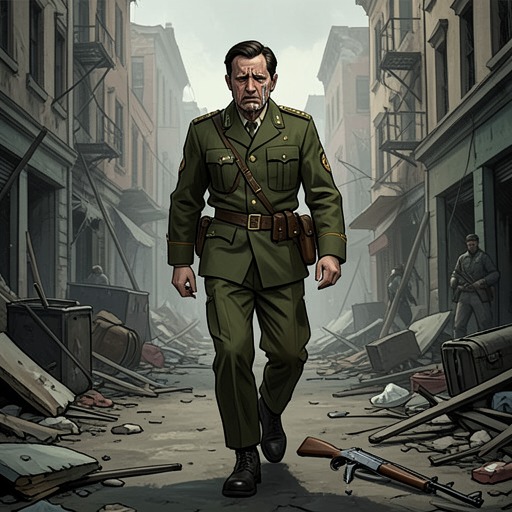
Bon’s postwar trauma and self-destructive despair
The SympathizerBon’s postwar trauma and self-destructive despair emerge from a collision between bereavement, military defeat, and his conviction that survival has stripped him of the identity he once possessed. He volunteers for a perilous expedition not because he expects to return, but because civilian life feels empty and his family’s loss has become inseparable from his judgment of himself. His exchanges with the unnamed narrator reveal both the force of that despair and the care that still binds them.
Loss and Displacement
When the unnamed narrator asks what became of the men’s wives and children, Bon’s companions describe families separated during the fall of Da Nang. The grizzled captain says his wife and children did not escape and that, as far as he knows, the Viet Cong sent them to clear swampland because they were related to him. He imagines going to retrieve them rather than simply waiting for their release. The affectless lieutenant offers no account beyond saying that his family is dead. Bon’s own grief belongs to this company of displaced men, but he carries it less openly: he rarely speaks about his wife, Linh, and child, Duc, to anyone except the narrator.
That silence breaks during an evening with Lana. As she and Bon reminisce about Saigon and its songs, she asks about his wife and child. Bon answers that they are dead, and tears run down his cheeks. The narrator is startled not only by the disclosure but by its setting: a conversation about music and memory has turned, as exile conversations often do, toward the fall of Saigon and the fate of those left behind. Lana embraces Bon and presses his head against her cheek. The narrator’s attention shifts from his attraction to her to an aching love for both of them; Bon’s grief becomes visible to someone beyond his closest friend, even as he seems overwhelmed by it.
The Expedition as a Death Wish
Bon volunteers for the reconnaissance mission to Thailand alongside men whom the narrator regards as dangerously willing to die. Under an oak tree, before a ten-mile hike, the narrator warns him that the other volunteers have no intention of coming back and calls the mission a suicide mission. Bon answers, “Life’s a suicide mission.” His remark is not merely a grim joke: he rejects the assumption that staying alive in exile is automatically preferable to risking death in combat.
The narrator presses him on what he could be living for. Bon describes their apartment as a jail cell without bars and says that the men have ceased to feel like men. He blames the Americans for first demanding that South Vietnamese fight on American terms, then rescuing them after defeat while leaving them emasculated and voiceless. His language turns political dependence into bodily humiliation: the Americans, in his account, have cut off their balls and cut out their tongues. The image expresses the loss of agency and speech that Bon associates with exile, not a literal injury.
Bon’s anger also reaches inward. The narrator argues that he had to retreat to save his family and that this does not make him less of a soldier. Bon refuses the consolation. He says the men still in South Vietnam, dead or imprisoned, at least know they are men, while no one in America fears the exiles except their own wives, children, and themselves. He describes hearing exiled men’s stories while selling them liquor, including accounts of men who shout at or sometimes beat their families to prove their masculinity. Against that distorted display of power, Bon defines a man as someone who protects his family and is willing to die for family, country, and comrades. He judges himself by that standard because he has lived to see his family die.
Argument with the Unnamed Narrator
The narrator tries to comfort Bon by putting a hand on his shoulder and calling his retreat an act of survival rather than cowardice. Bon shrugs the hand away. The narrator has not heard him speak so bluntly about his pain before, and the refusal of comfort makes the distance between their understandings plain: the narrator sees survival as an obligation and asks whether Bon should wait for a later force that might have a genuine chance, while Bon sees the prospect of waiting as another excuse to remain in a life without purpose.
Bon condemns most of the volunteers as bluffers. The General asked for volunteers and received only three, he says; others talk like soldiers but hide behind the families they resent themselves for hiding behind. The narrator calls him cynical and asks what he is dying for. Bon reverses the question: “I’m dying because this world I’m living in isn’t worth dying for!” If something is worth dying for, he adds, then a person has a reason to live. The narrator has no answer. The exchange leaves Bon’s motive deliberately double-edged: he presents death as a response to an intolerable world, yet the possibility of fighting for something also offers a reason to live.
Care, Guilt, and Return to Combat
Bon’s despair does not erase his capacity to care for the narrator. The morning after the narrator assassinates Sonny, Bon gives him scotch supplied by the General and tells him that what happened had to be done and that they are the ones who must live with it. He urges the narrator to drink and says that getting back to the battlefield will make him feel better in Thailand. The advice turns combat into a remedy for guilt, echoing Bon’s own belief that danger can provide a reason to live. The narrator, however, cannot forget the killing, even after returning to Lana.
The departure is arranged quickly. The narrator is returning with Bon because he believes he has brought him into this situation and must try to get him out of it, though he has no plan for how to save him. Two days after Sonny’s death, the narrator, Bon, the grizzled captain, and the affectless lieutenant leave the United States together. Bon’s movement toward combat thus has a double meaning: he is accompanying his friend, but he is also renewing the course he had described as a possible death sentence.
Significance
Bon’s postwar despair is expressed through a conflict over what counts as manhood and what survival means after military defeat. He condemns the exiles’ empty performances of soldiering, yet seeks a return to war as the setting in which courage, loyalty, and sacrifice might again become legible. His grief for Linh and Duc deepens that contradiction: he says a man protects his family, then measures himself against the fact that he survived them. The unnamed narrator’s attempts to comfort him and later to take responsibility for his safety make their friendship a counterforce to his isolation, but neither affection nor a new mission resolves the grief. The expedition offers Bon purpose without promising recovery; its appeal lies precisely in the possibility that it may cost him his life.